For the first time since the modern poverty measure was introduced in the 1960s, fewer than 100,000 Cleveland residents lived in poverty in 2025. Just over 85,000 of Cleveland’s 353,400 residents had household income below the poverty threshold,dropping Cleveland’s overall poverty rate to 24.1 percent.
This is the first time since 1980 that fewer than one quarter of residents lived in poverty. The economic improvement for low-income families mirrors national trends, and Cleveland remains the second poorest large city in the United States for another year. According to the U.S. Census Bureau’s American Community Survey one-year estimates, the poverty rate fell from 28.3 percent in 2024, a statistically significant decline.
But that progress masks substantial differences by race and ethnicity.
The decline was largely driven by improvement among non-Hispanic white residents, while poverty remained much higher among residents of color.
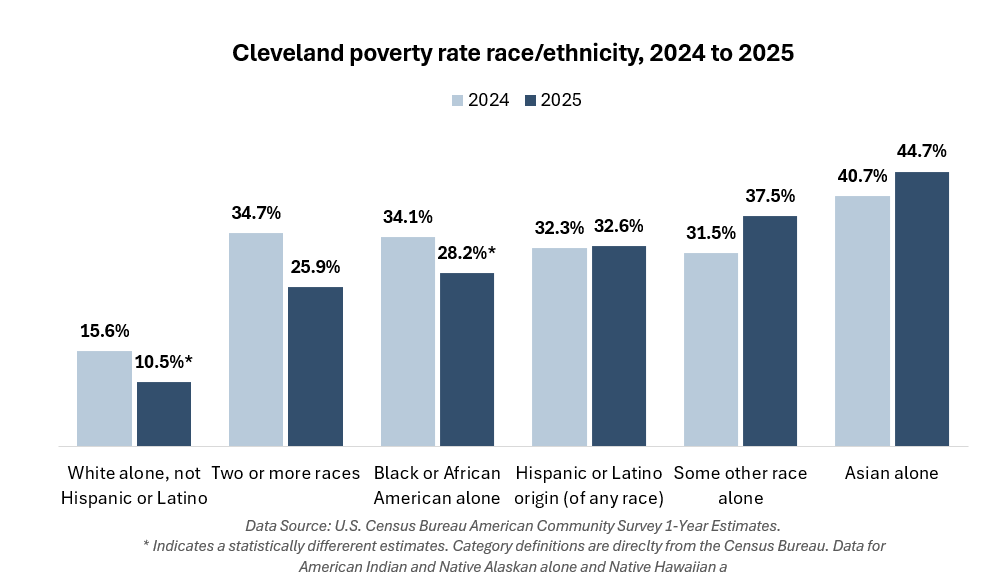
The disparities are striking.
In 2025, nearly 45 percent of Cleveland’s 10,500 Asian residents livedin poverty, as did about one in three of the city’s 53,400 Hispanic/Latinoresidents.
Both rates were significantly higher than the poverty rate among non-Hispanic whiteCleveland residents.
Cleveland stands out nationally
Among U.S. cities with populations greater than 300,000, Cleveland had the highest poverty rate for Hispanic/Latino residents and the highest poverty rate for Asian residents. Cleveland’s Black poverty rate was second-worst, just ahead of Detroit. The 10.5% poverty rate for non-Hispanic white residents places Cleveland much further down the list, at 22nd according to 2025 estimates.
Cleveland has more poor Hispanic/Latino residents than some cities withHispanic populations more than twice our size, like San Francisco and Oaklandin California and Tampa and Orlando, Florida.
Challenges facing Asian and Asian American residents are persistent. Cleveland had the worst Asian poverty rate of any large city since at least 2021.

The year-to-year changes provide another indication that Cleveland’s economic progress is uneven. From 2024 to 2025, the poverty rate among Black residents and among non-Hispanic white residents improved, while the rate among Hispanic/Latino residents and Asian and Asian American residents worsened.
These disparities shape who is living in poverty in Cleveland.
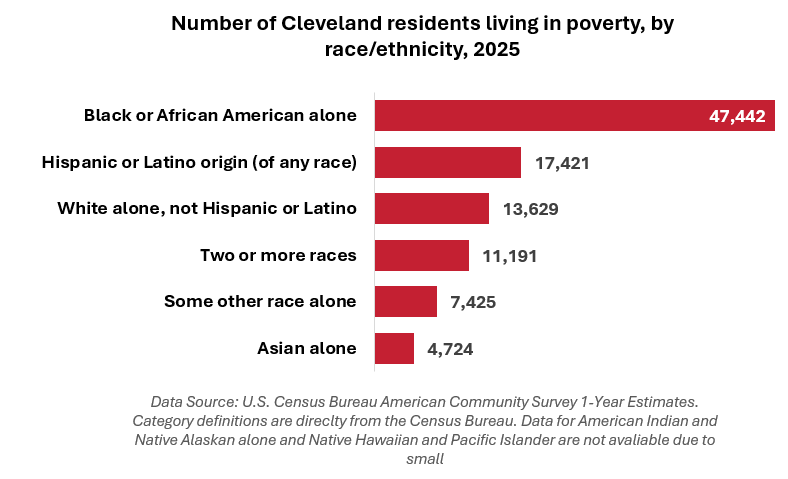
- Non-Hispanic white residents make up 29 percent of Cleveland’s population, but only 12 percent of Cleveland residents living in poverty.
- There are more Hispanic residents than non-Hispanic white residents living in poverty.
- Roughly 4.5 times as many Black residents lived in poverty as their non-Hispanic white neighbors.
Cleveland will not be able to sustain the economic improvements and substantially reduce poverty without expanding economic opportunity for residents of color. An improving citywide poverty rate is important, but it is not sufficient if that progress is concentrated among only part of the population.