Many disparities and gaps in care are creating significantly worse mental health challenges facing people across the state. These challenges should be highlighted to help identify opportunities to strengthen mental health systems. Mental Health Awareness Month, celebrated in May, helps to elevate this need annually.
Clifford Beers, founder of Mental Health America (MHA) and author of “The Mind that Found Itself” spent decades advocating for reform in psychiatric systems and mental health treatment. After his death in 1943, MHA launched the first awareness campaign for mental health in 1949. For more than 75 years, Mental Health Awareness Month reminds providers, advocates, nonprofits, and community members to come together to reduce stigma surrounding mental health and increase awareness.
Ohio’s mental health challenges: Treatment, workforce, and shortages
Rates of mental distress and depression have increased significantly, according to the Health Policy Institute of Ohio (HPIO),. In 2024, 27 percent of adults ages 18 and older were diagnosed with depression, marking a 6 percent increase from 2015. That same year, 17 percent of adults in the same age category reported experiencing more than 14 days of poor mental health in a month, a 32 percent increase from 13 percent in 2016.
Ohio is not fully meeting the mental health needs of individuals. In fact, in July 2025, 75 of Ohio’s 88 counties were designated a mental health shortage area. Among the 75 counties were Cuyahoga, Franklin, and Hamilton County, the most populated counties in the state.
This is almost a ten percent increase from 2021, when 66 percent of Ohio counties were designated a mental health shortage area. Additional shortages in the behavioral health workforce and changes to Medicaid under HR 1 creates an unprecedented environment that challenges providers to sustain the workforce and finance mechanisms necessary to fulfill need.
What can be done to improve the current situation?
Despite these challenges, there are some promising avenues for policy. The first is to combat sigma against mental illness. Stigma against mental illness reduces the ability for legislation to be developed that can promote insurance parity. The subsequent lack of healthcare coverage for mental health leaves many people without treatment, creating a vicious feedback loop that exponentially impacts vulnerable people.
Secondly, peer support services needs further investment as a resource and intervention for individuals seeking care. Having people with lived experiences meet with and connect with vulnerable people can ultimately push for better outcomes. As of January 2025, Ohio has over 3,500 peer supporters. Further legislation that supports peer support services and community-based organizations can help close gaps in Ohio.
The outlook is not as grim as it seems
Despite the current challenges impacting Ohio, there are notable developments to highlight that demonstrate the state’s work to advance mental health:
- Last year, the Department of Behavioral Health collaborated with the Department of Medicaid to expand Mobile Response and Stabilization Services throughout the entire state. Twelve organizations in total are responsible for 18 regions. This significantly increases the ability for crisis response directly to people in need.
- In 2024, Ohio invested in broadband extension to improve internet coverage throughout the state. In doing so, it closes gaps in connectivity that makes it harder for people to receive telehealth services. HB 33 of the 135 GA launched the Pole Replacement and Undergrounding program to improve infrastructure for internet providers. In 2025, Governor DeWine and BroadbandOhio invested $6.3 million to expand access through this program.
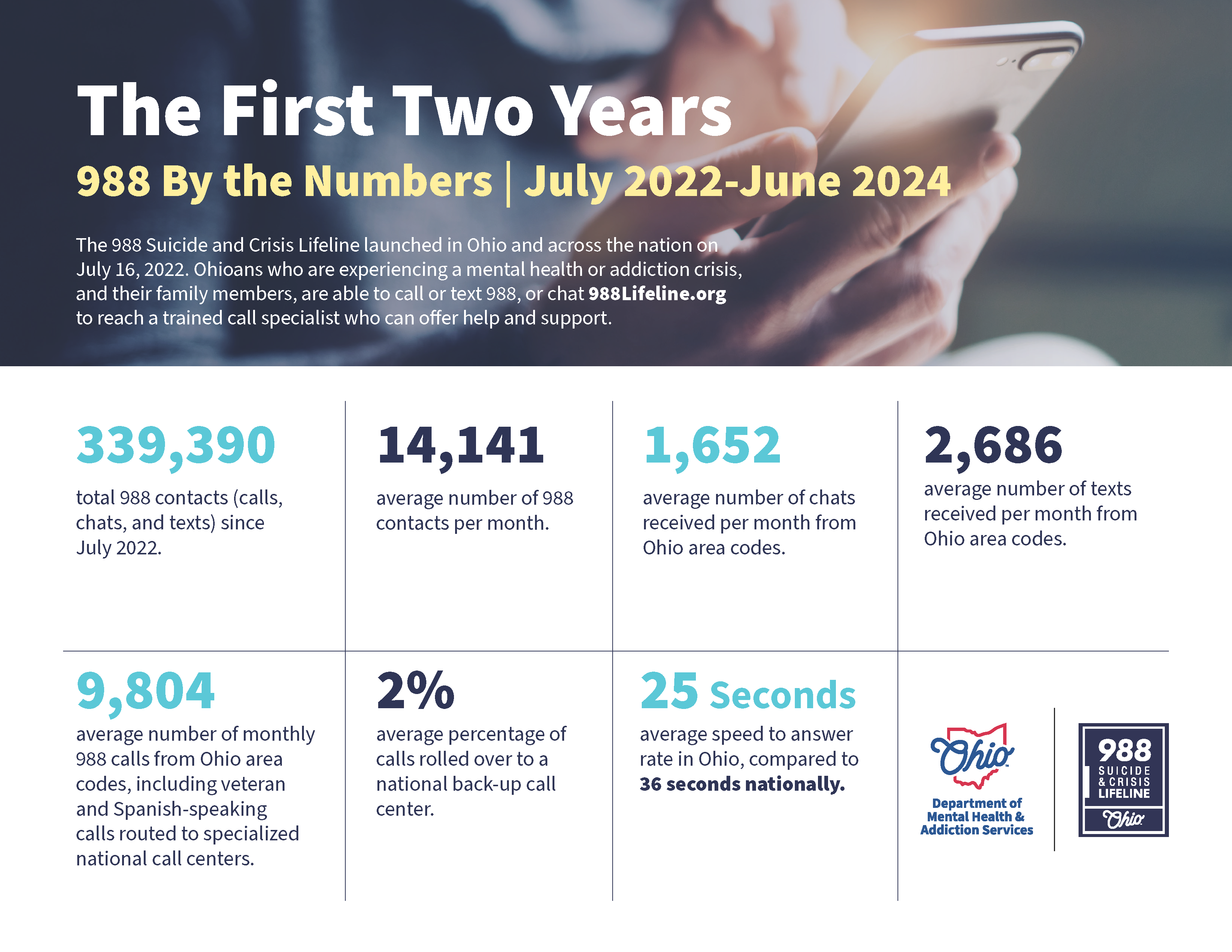
- More people are using the 988 Lifeline to address mental health needs. A 2025 statement from Department of Behavioral Health reported that the 988 Lifeline has over 500,000 total texts, calls, and chats since 2022. The average number of contacts per month is 16,453. This is an increase from the 2024 report showing 339,390 total contacts. In April 2026, new data concluded that suicide rates had dropped 11 percent among 15 – 23-year-olds.
- Crisis centers continue to open across the state, expanding access to care. In 2025, Franklin County, Cuyahoga County, and Hamilton County opened crisis center facilities or committed funds to develop them. These efforts expand care to Ohioans that need them most.
Mental Health Awareness Month is a time to raise awareness and address stigma
Mental Health Awareness Month is a time for providers, communities, and nonprofits to come together to address stigmas facing mental health. More should be done to address specific needs of Ohioans to produce a healthier future for all its residents. For more information and resources, check Mental Health America’s website for other resources.
Other events throughout the month:
- Ohio State University Mental Health Fair
- Mental Health America Day of Action
- Register for NAMIWalks Ohio location—Ohio location
- Ohio 2026 Mental Health Conference
Additional Resources: