



Last year, as Cuyahoga County entered its biennial budget process, the fiscal outlook was challenging. Federal COVID relief dollars were gone, the Health and Human Services levy fund was projecting a $20.7 million deficit, and the general fund was projecting a deficit of $47.8 million. Even after accounting for $32.6 million in expenditures supported by American Rescue Plan Act (ARPA) dollars, the general fund deficit stood at $15.2 million.
To face those challenges, the County broadly took two approaches. It tightened its own belt, and it reduced external expenditures on contracts, programs, and subsidies to local organizations.
Now, one year later, County Executive Chris Ronayne has submitted his recommended budget update to County Council to make adjustments for 2027. His recommended budget does not reflect additional funding from the recently approved levy, as the budget was submitted prior to Election Day and the levy outcome was uncertain.
While County Council will likely be tempted to restore its own spending and external funding for local partners in the new year once the newly-approved levy dollars start flowing the County needs to approach this budget update carefully and deliberately, as many of the pressures facing the County have not disappeared and, in certain areas, continue to grow.
A County budget update, not a full budget process
The County needs to ensure it does not treat the budget update process as a biennial budget process and instead addresses only what absolutely must be addressed in 2027.
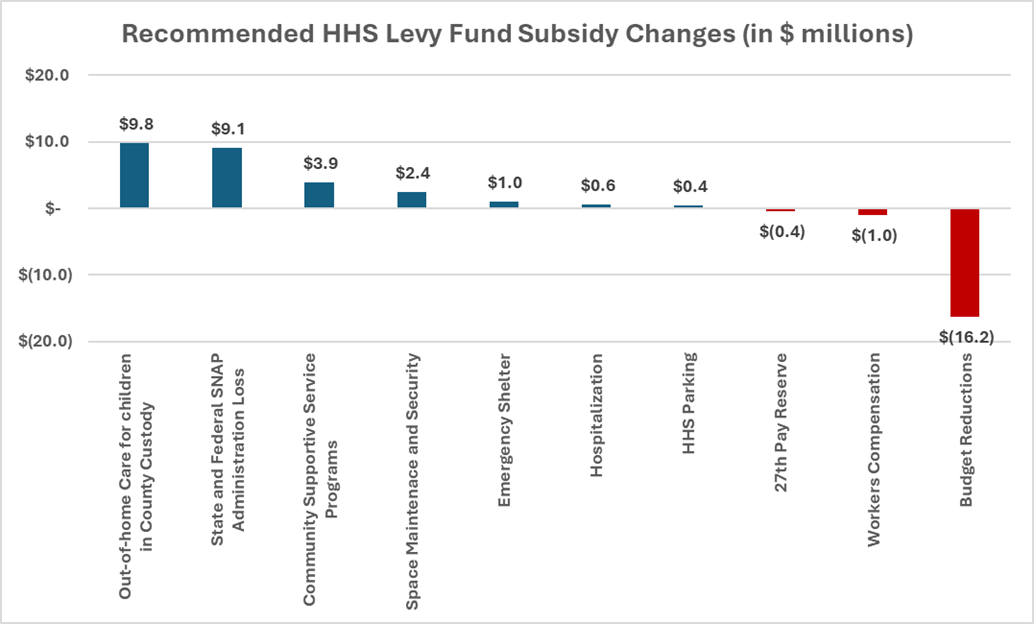
The County Executive’s recommended budget provides a perfect example of this, as it includes an additional $9.1 million for the County’s role in administering the Supplemental Nutrition Assistance Program (SNAP). This additional funding is needed to address federal policy changes that began on October 1, 2026 the beginning of federal fiscal year (FFY) 2027, related to the financing of the administrative costs associated with running the SNAP Program.
While H.R. 1, the bill responsible for the SNAP changes, was signed into law months before the County kicked off its budget process, the County correctly waited until it had more information prior to making any decisions related to the legislation. Now that Congress will have new leadership, some of the changes and cuts in H.R. 1 may be overturned or delayed.
Even though policymakers in Washington have said this is a priority, the County shouldn’t rely on it.
It is imperative for the County to continue its practice of waiting until more is known prior to making a decision. The $9.1 million is needed for SNAP administration because the state opted to pass the pain of federal cuts to only the largest counties. While the state covered the full federal reduction of SNAP administration costs for more than 50 counties, Cuyahoga County only received 3% of its expected reduction, forcing us to find local resources to make up the rest. Administering SNAP is a required and mandated service, so the County has no choice but to produce the funding. The new levy means the County won’t have to cut elsewhere.
The new Governor and State Legislature will decide how to address SNAP administration cost sharing for future years when they debate the state budget in the first half of 2027. Next fall, when the County begins its new biennial budget process, the state’s strategy, and approach to financing the SNAP administrative costs will be known. Additionally, it is unclear what, if anything, the federal government will change regarding H.R. 1, as power dynamics in Washington, D.C., have shifted, with party control changing in the United States Senate and House of Representatives.
In a changing policy environment, it is impossible to predict future needs
A perfect example of why the County should wait is directly related to H.R. 1 and its changes to the SNAP Program.
Starting on October 1, 2027, the beginning of FFY 2028, states with a SNAP Error Rate above 6% will begin to pay a portion of SNAP food benefit costs. This monumental change in how the SNAP Program is financed could be delayed, as negotiations over the Senate Agriculture Committee’s Farm Bill included whether to implement a one-year or two-year delay.
While this legislation still has a long way to go before passage during the current Congress, it could move during the next Congress when one party has control over the entire legislative branch.
On the other hand, we don’t know the impact that new work requirements for Medicaid expansion will have on coverage. About 40 percent of enrollees in Medicaid expansion had a primary mental health or substance use disorder diagnosis. If those individuals lose health coverage, our health systems and behavioral health providers could see enormous increases in uncompensated care. If that happens, the ADAMHS Board and MetroHealth will likely seek an even greater share of levy funds.
These uncertainties are a perfect example of why the County should wait until more is known prior to committing large buckets of funding one way or another. The County should hold off on making large investments with the new HHS Levy funding.
One area where the County should make investments immediately is hiring, specifically within the Department of Job and Family Services (JFS).
By removing the hiring freeze for JFS, the County will not only be in a better position to keep its SNAP Error Rate down, which will save the state money whenever this change is implemented, but will also provide a better consumer experience, as there will be more call center staff members to field calls.
The recommended updates make appropriate changes
The final reason the County should treat this budget update as an update, not a quasi-budget cycle, is fiscal responsibility. While fiscal responsibility does not always mean spending less, it can mean spending smarter, such as removing the hiring freeze for JFS. At the same time, the County should work to spend less or, at a minimum, not increase spending to match new revenues.
The County has already had to go out to the voters earlier than expected, largely due to forces outside the County’s control.
However, the inability or unwillingness of County Council to rebuild the HHS Levy Fund so that it lasts the entire ten years of the levy would be fiscally irresponsible and detrimental to the voters of Cuyahoga County.
Overall, the recommend HHS levy fund budget adjustment includes $6.9 million more revenue, representing $6.2 million in additional property tax collections, most from delinquency collections, and around $700,000 in additional intergovernmental revenue from the Public Assistance and State Homestead credit. Operating Expenditures represent the cost of the property tax collection for the Health and Human Service levies and is projected to increase 38.9% from the adopted budget, rising to $5.3 million.
Most of what is typically thought of as HHS Levy spending is represented by “Subsidies to Other Funds,” representing the county share of the cost to operating health and human service agencies and departments and the subsidies to ADAMHS Board and MetroHealth.
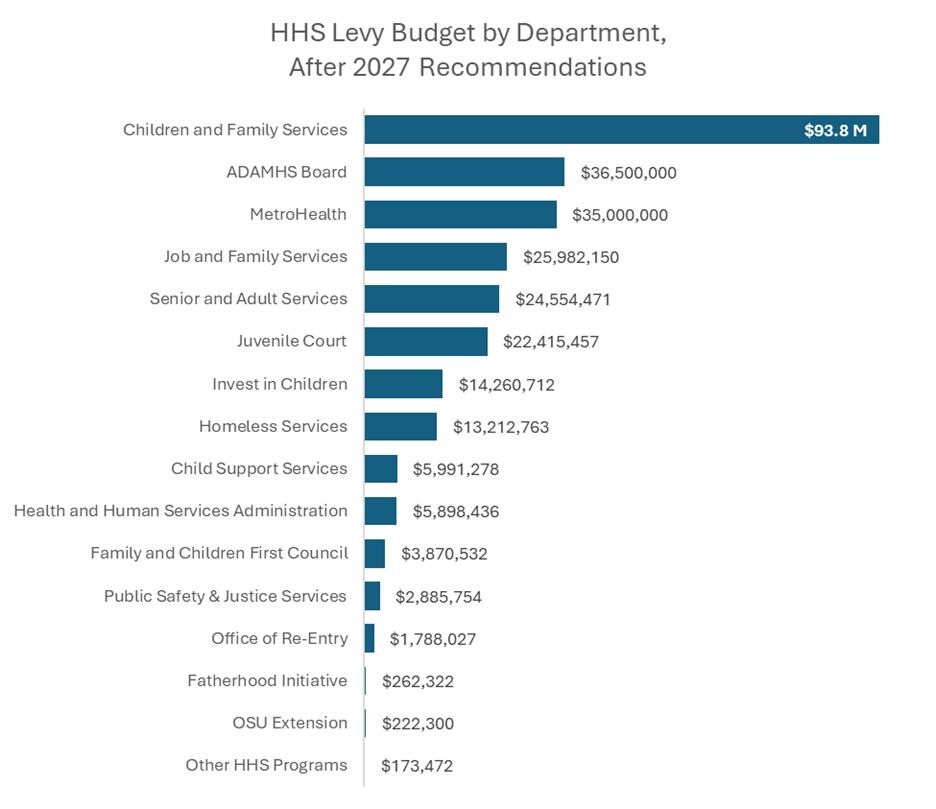
If all recommended changed are adopted by Council, the Division of Children and Family Services would account for close to one-third of all HHS Levy outlays. ADAMHS Board (12.7 percent of total), MetroHealth (12.2 percent), and Cuyahoga Job and Family Services (9.1 percent) comprise the next third.
As Council and the Executive consider how to invest new levy dollars, they should consider how much is needed for mandated government operations and how much can support services at organizations and providers throughout the community.
The new recommendations project an HHS levy fund balance of only $8.3 million at the end of 2027 or about 2.9 percent of annual HHS levy fund revenue.
Smart spending now will allow new resources to last
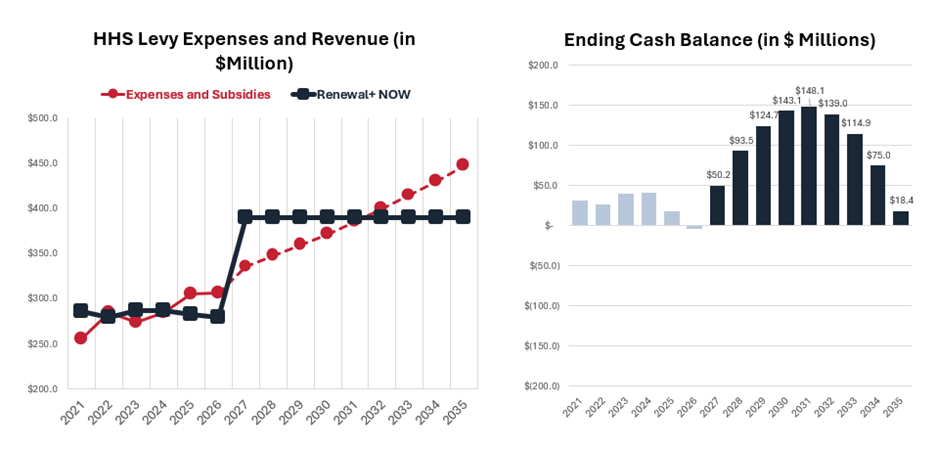
Projections released by Cuyahoga County when considering whether to put the renewal and increase on the ballot demonstrate the importance of building reserves during the first half of a levy’s lifespan to make it through the levy’s period without having to ask voters for more.
As the chart below shows, expenses are projected eclipse levy revenue in 2032, even without substantial new programs. These estimates do account for a 3 percent annual increase in County employee salaries, a 10 percent annual increase in health coverage costs, and a 5 percent increase in non-personnel expenses. It assumes flat funding over the next decade for MetroHealth at the current level of $35 million per year, and an increase for ADAMHS Board to $41 million per year in 2027 and later.
HHS Levy projected revenue, expenses, and ending cash balance through 2035, based on information released in July, 2026
As with many budget processes, the path forward will demand hard choices and honest dialogue.
Budget decisions are never easy, and this year will be no exception.
No one is doubting that the needs of community members are urgent and grave, but the County needs to have the difficult conversations necessary to not only ensure this levy lasts the full ten years, but also to preserve the services our communities rely on in the long term.