Poverty & Safety Net
Article

Who pays for federal SNAP cuts? Only the largest counties, under the Ohio house plan

Emily Campbell
Chief Executive Officer
Additional Contributors
No items found.
Read time:
Download Fact Sheets
Register now
Share this resource
Subscribe to our Newsletter
By subscribing you agree to with our Privacy Policy.
Thank you! Your submission has been received!
Oops! Something went wrong while submitting the form.
Download this as a PDF

When it comes to funding counties, equal isn’t fair, especially when need is uneven. Last year’s federal reconciliation bill, sometimes called the “One Big Beautiful Bill Act” cut federal funding for SNAP administration. As a result, states must cover a much larger share of the cost of running this federal program. The Ohio Legislature’s response shifts the burden unevenly; House Bill 730 includes $10 million of state funds and $2.5 million federal funds to make a “supplemental” payment of counties’ SNAP administration costs. Rather than allocating funds based on where SNAP recipients live—as the state has traditionally done—the Ohio House plan protects smaller counties while pushing the largest costs onto counties with the most residents receiving SNAP.  

Flat funding may sound fair. In practice, it penalizes size and need.

Historically, Ohio has allocated SNAP administrative funding so that resources followed caseloads. The House plan breaks from that precedent. Instead of targeting dollars to counties facing the largest federal cuts, a limited pool of state and federal resources is distributed evenly across county Job and Family Service departments, stopping once a county’s expected loss is met or the money runs out.  

Under this approach, 59 counties facing federal funding losses under $220,000 are fully covered. Seven other counties have at least 75 percent of their costs covered. The remaining county Job and Family Service departments receive the same capped amount, $226,486, regardless of the scope of expected federal funds reduction. This includes South Central JFS which comprises Ross, Hocking, and Vinton counties.  

This approach fully protects smaller counties with modest losses, while leaving larger counties to somehow absorb the remaining costs on their own.  

Counties serving the most people are asked to absorb the largest losses. They must divert local dollars to meet this unfunded mandate. The greatest impact is for Summit ($1.35 million remaining), Montgomery ($2.2 million), Lucas ($2.4 million), Hamilton ($2.5 million), Franklin ($5.4 million), and Cuyahoga ($7.3 million). The map below shows the percentage of the expected federal reduction covered by the House plan.  
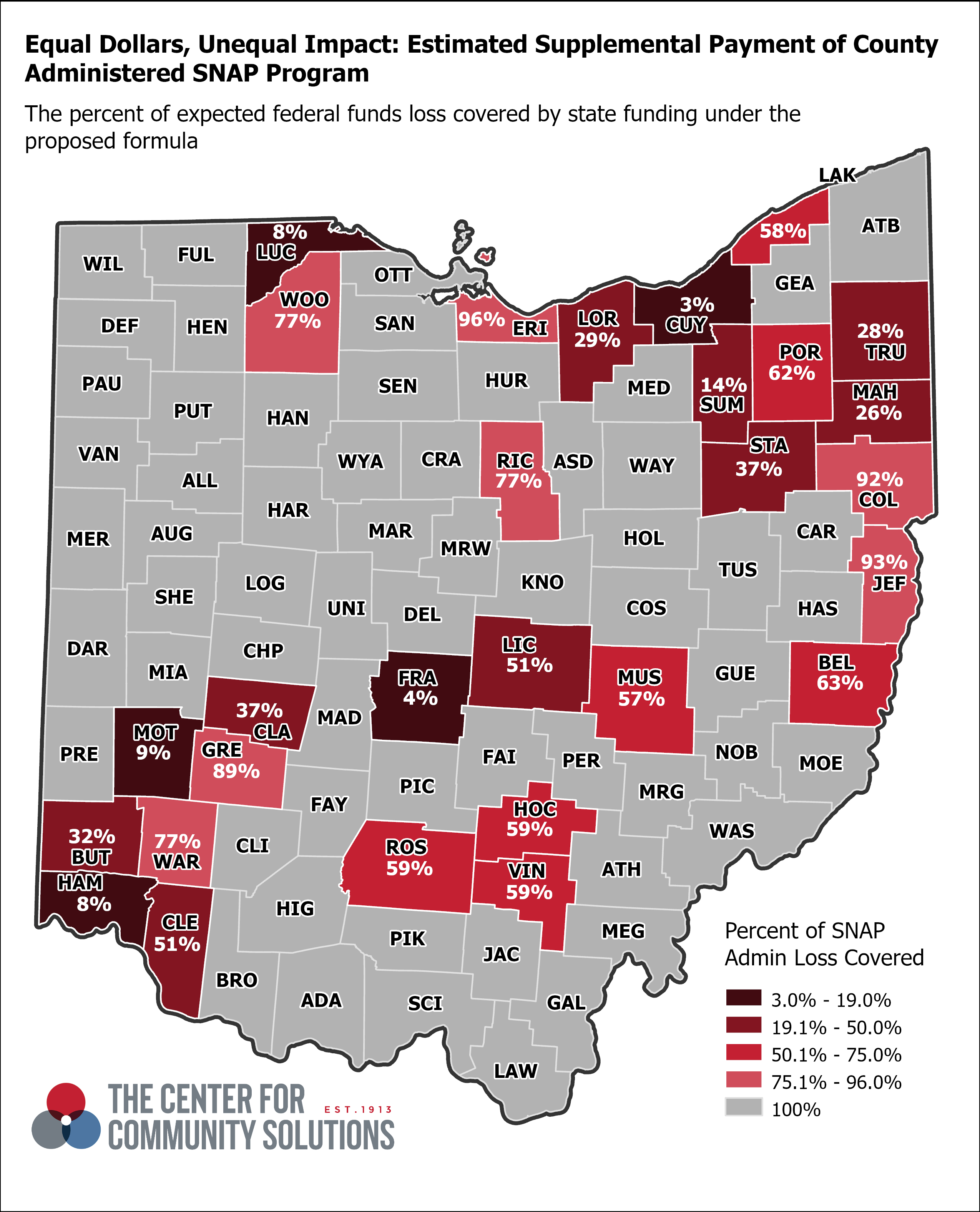
View the Estimated Supplemental Payment of County Administered SNAP Program Table
The money isn’t targeted and it isn’t enough.

Roughly one quarter of SNAP recipients live in counties that are fully protected under this proposal. The remaining 76 percent live in counties where local governments are left to figure out how to cover the shortfall. Supporters of the plan argue that large counties can handle the costs because they have larger overall budgets. That argument ignores a basic reality. Larger counties have larger budgets because they serve more people, including more people receiving SNAP.  

Counties cannot change eligibility rules or benefit levels. Those decisions are made at the federal level. When administrative costs rise, counties have only one option and must divert local money from locally determined priorities to meet federal requirements and keep the program running.  

A short-term patch, not a solution

The inequity is compounded by timing. The $10 million in state funding included in the House plan covers only about one-third of the total federal SNAP administrative cut for the first nine months of these new, ongoing costs. Much more is needed; this is not a long-term fix. It is a temporary patch that leaves the deepest holes where need is greatest.  

Efficiency means targeting resources where need is highest, not spreading dollars evenly and calling it fair.

The Senate should adopt a more targeted funding formula which follows the state’s longstanding practice. Residents of large counties shouldn’t be the only ones asked to feel the pain of federal cuts.  
Download Fact Sheets

All Cleveland Wards

Download

Cleveland Ward 15

Download

Cleveland Ward 14

Download

Cleveland Ward 13

Download

Cleveland Ward 12

Download

Cleveland Ward 11

Download

Cleveland Ward 10

Download

Cleveland Ward 9

Download

Cleveland Ward 8

Download

Cleveland Ward 7

Download

Cleveland Ward 6

Download

Cleveland Ward 5

Download

Cleveland Ward 4

Download

Cleveland Ward 3

Download

Cleveland Ward 2

Download

Cleveland Ward 1

Download

District 15 | Federal Congressional

Download

District 14 | Federal Congressional

Download

District 13 | Federal Congressional

Download

District 12 | Federal Congressional

Download

District 11 | Federal Congressional

Download

District 10 | Federal Congressional

Download

District 9 | Federal Congressional

Download

District 8 | Federal Congressional

Download

District 7 | Federal Congressional

Download

District 6 | Federal Congressional

Download

District 5 | Federal Congressional

Download

District 4 | Federal Congressional

Download

District 3 | Federal Congressional

Download

District 2 | Federal Congressional

Download

District 1 | Federal Congressional

Download

Ohio Statewide Data

Download

Wood County

Download

Wyandot County

Download

Williams County

Download

Washington County

Download

Vinton County

Download

Wayne County

Download

Warren County

Download

Van Wert County

Download

Union County

Download

Tuscarawas County

Download

Stark County

Download

Summit County

Download

Trumbull County

Download

Shelby County

Download

Seneca County

Download

Scioto County

Download

Ross County

Download

Sandusky County

Download

Richland County

Download

Putnam County

Download

Huron County

Download

Portage County

Download

Preble County

Download

Pike County

Download

Pickaway County

Download

Perry County

Download

Noble County

Download

Paulding County

Download

Ottawa County

Download

Morrow County

Download

Muskingum County

Download

Morgan County

Download

Montgomery County

Download

Meigs County

Download

Monroe County

Download

Miami County

Download

Mercer County

Download

Marion County

Download

Madison County

Download

Medina County

Download

Mahoning County

Download

Lucas County

Download

Lorain County

Download

Logan County

Download

Licking County

Download

Lawrence County

Download

Lake County

Download

Holmes County

Download

Jackson County

Download

Knox County

Download

Jefferson County

Download

Hocking County

Download

Henry County

Download

Highland County

Download

Harrison County

Download

Hancock County

Download

Hardin County

Download

Greene County

Download

Geauga County

Download

Guernsey County

Download

Hamilton County

Download

Gallia County

Download

Fayette County

Download

Fulton County

Download

Franklin County

Download

Fairfield County

Download

Erie County

Download

Darke County

Download
Thank you! Your submission has been received!
Oops! Something went wrong while submitting the form.
Download report

Subscribe to our newsletter

5 Things you need to know arrives on Mondays with the latest articles, events, and advocacy developments in Ohio

Explore the fact sheets

Lorem ipsum dolor sit amet, consectetur adipiscing elit. Suspendisse varius enim in eros elementum tristique.

No Related Fact Sheets