Nearly 300 self-identified LGBTQ+ allies shared their beliefs, behaviors, and experiences through the 2024 Greater Cleveland LGBTQ+ Community Needs Assessment. The data collected makes it clear that LGBTQ+ allies are already here. They care. They want to do the right thing for people they care about. But wanting to act and knowing how, when, and where to act are not the same thing, and we all have a level of responsibility in closing that gap.
When everybody had different ideas, and yet we all decide to move in the same direction—that’s a movement ~ Loretta Ross
LGBTQ+ allyship has never had a fixed definition, and perspectives on its role among LGBTQ+ community leaders and advocates historically differ. Professor Loretta Ross offers a useful frame: “When everybody thinks the same thing, and we move in the same direction—that’s a cult. When everybody has different ideas, and yet we all decide to move in the same direction—that’s a movement.” Within that reality, community must come to accept that LGBTQ+ allies are part of the landscape of the LGBTQ+ movement. For them to contribute to the movement’s forward momentum, we must understand what allies believe, what they do, and what they need to be the best allies they can be.
LGBTQ+ allyship is already present
LGBTQ+ allyship is widespread and deeply personal. The Greater Cleveland LGBTQ+ Community Needs Assessment was a monumental collective community undertaking surveying over 1500 LGBTQ+ community members on their most pressing needs to inform investments in community action. One thing many overlook is that a separate set of questions for LGBTQ+ allies were also included in the project. The fact that nearly 300 LGBTQ+ allies participated in an LGBTQ+ survey without any formal recruitment underscores that allies are present and ready to act.
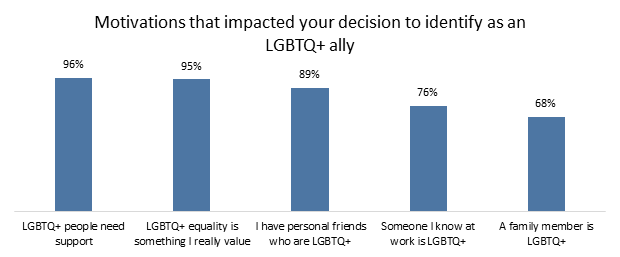
More than 95% of respondents said their allyship is rooted in a belief that LGBTQ+ people need support and that equality aligns with their values.
Not far behind in the data, LGBTQ+ allies share that their support is also heavily shaped by relationships such as friends, coworkers and family members who identify as LGBTQ+. Although this understanding is not a shocking discovery, it is important to note that alignment of values and beliefs doesn’t necessarily make for an actionable LGBTQ+ ally.
What’s getting in the way?
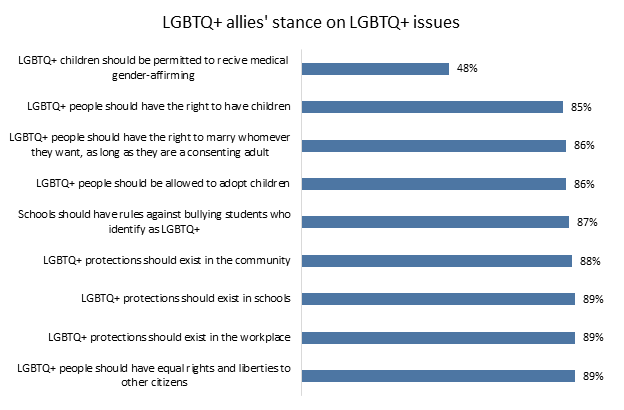
Across nearly every measure, LGBTQ+ allies overwhelmingly support LGBTQ+ rights and protections. Support for nondiscrimination, inclusion in schools and workplaces, and equal rights is high. This alignment between allies and LGBTQ+ communities reflects a cultural baseline that LGBTQ+ communities have worked toward over decades.
But values alignment is only one part of the equation.
The survey questions then shift from whether LGBTQ+ allies agree on LGBTQ+ issues, to the types of actions they are equipped and ready to take in meaningfully ways that support LGBTQ+ people in the fight for equity in their daily lives.
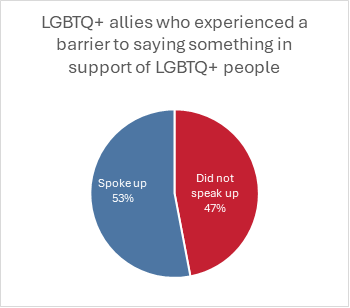
Almost half (47%) of LGBTQ+ allies said there were times that they wanted to say something in support of LGBTQ+ people, but something stopped them.
Sixty-seven percent of allies indicated that not being sure about specific things they could do to help LGBTQ+ people impacted their ability to be an effective ally. Eighteen percent of allies indicated they were very impacted by not knowing what specific actions to take, while another 24% reported this as moderately impactful.
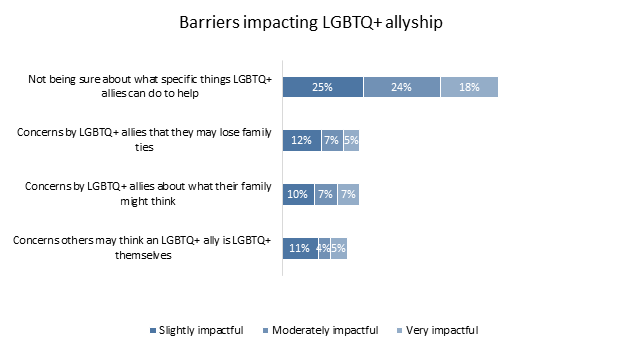
Other barriers to effective allyship such as concerns about familial relationships and being mistaken for being part of the LGBTQ+ community do not present as much as an obstacle as not knowing what or how to help LGBTQ+ people.
Questioning general knowledge about LGBTQ+ issues and protections in employment, housing, and public accommodation further illuminate a knowledge gap between LGBTQ+ allies and the lived LGBTQ+ experience.
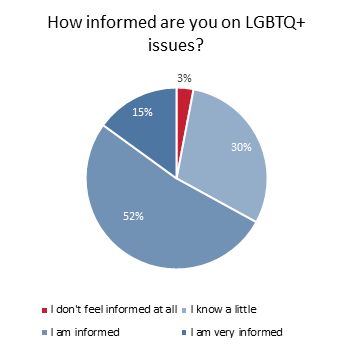
While 67% of LGBTQ+ allies describe themselves as informed or very informed, just 30% report only knowing a little about current LGBTQ+ issues while another 3% don’t feel informed at all.
There is also notable uncertainty when questioned on their understanding around nondiscrimination protections in the State of Ohio; 26% of LGBTQ+ allies are unsure and 27% believe LGBTQ+ individuals are protected from discrimination in employment, housing, and public accommodations in the State of Ohio—when in fact they are not.
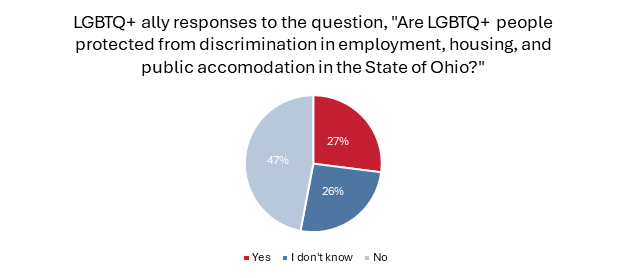
Being informed about LGBTQ+ issues is important; because even with strong values alignment, misinformation and knowledge gaps can cause LGBTQ+ allies hesitation to act.
Additional findings on LGBTQ+ allyship are available on page 140 of the report.
Allyship is happening, but not always where and how it’s needed the most
“Knowledge is not power; knowledge plus action equals power” is a common principle of advocacy and activism. Applying knowledge through direct action is what creates impact, and I would take it one step further to say applying it intentionally where and how it is needed most matters.
This means it’s not enough to simply address this gap by educating LGBTQ+ allies. We also need to understand the barriers they experience in taking action to support LGBTQ+ communities and individuals.
LGBTQ+ allies are not operating in a vacuum. Even with varying levels of education and knowledge about LGBTQ+ issues, many LGBTQ+ allies report regular social encounters such as hearing anti-LGBTQ+ discussions, jokes, or witnessing exclusion.
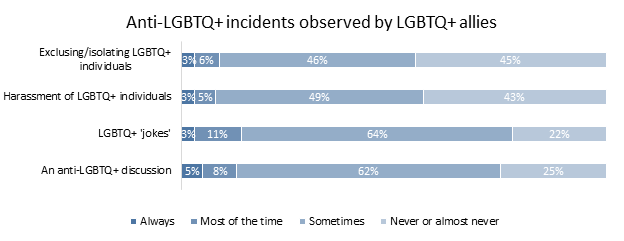
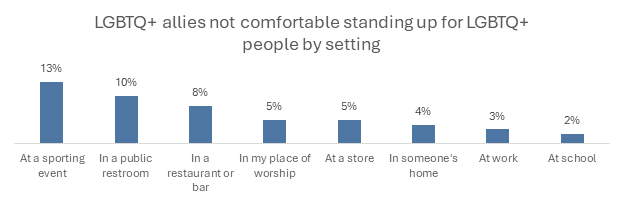
At the same time, comfort levels of addressing LGBTQ+ exclusion or discrimination seem to also vary depending on the setting.
LGBTQ+ allies surveyed report feeling more comfortable standing up for LGBTQ+ people in certain environments.
Among the spaces respondents indicated feeling less comfortable standing up for LGBTQ+ people were in settings like sporting events, public restrooms, in restaurants, or in a place of worship where discrimination protections and policies (such as HR policies or codes of conduct) don’t exist to protect not just the LGBTQ+ person, but also the LGBTQ+ ally who stands with them.
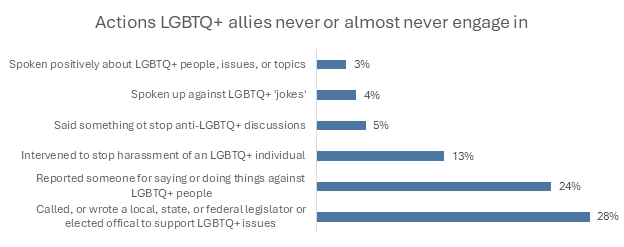
Finally, when asked about the types of actions LGBTQ+ allies have (or have not) taken, the data shows a clear pattern. Allies are more likely to “speak-up” in defense of an LGBTQ+ individual than to take more formal or higher-risk actions such as intervening in harassment, reporting harmful behaviors, or contacting elected officials.
Feeling supported as an LGBTQ+ ally
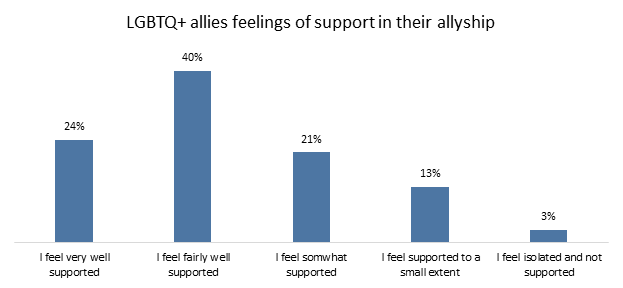
Most LGBTQ+ allies report feeling generally supported in their allyship, but that support is not consistent or universal and therein lies another problem. A majority fall into the middle with 40% feeling fairly supported, and another 21% feeling somewhat supported, suggesting that while allyship is recognized, it is not always reinforced in meaningful ways. At the same time, nearly one in six allies report limited or no support at all, including 13% who feel supported only to a small extent and 3% who feel isolated. This uneven distribution points to a gap: allyship may be present, but the systems, communities, and environments that sustain and encourage it are not always as visible or reliable as they need to be.
What it really takes to activate allyship
While gaps in understanding remain, this deeper dive into the data highlights the presence of real barriers to consistent support beyond knowledge gaps that shape whether allies can act at all. Knowing what to do, feeling supported enough to do it, and navigating environments that either enable or discourage action are all part of the equation. When any of these components are missing, LGBTQ+ allyship stalls. When all are present, allyship becomes more consistent, visible, and effective.
When allies are equipped, we know their presence changes environment. It makes spaces safer. It makes systems more responsive. It makes support visible in ways that matter rather than visibility for its sake.
There is an opportunity here, not just to ask more of LGBTQ+ allies, but to invest in them. To make LGBTQ+ allyship something that informed, invested in, practiced, and supported, rather than simply proclaimed.
*No AI was used in this blog.