


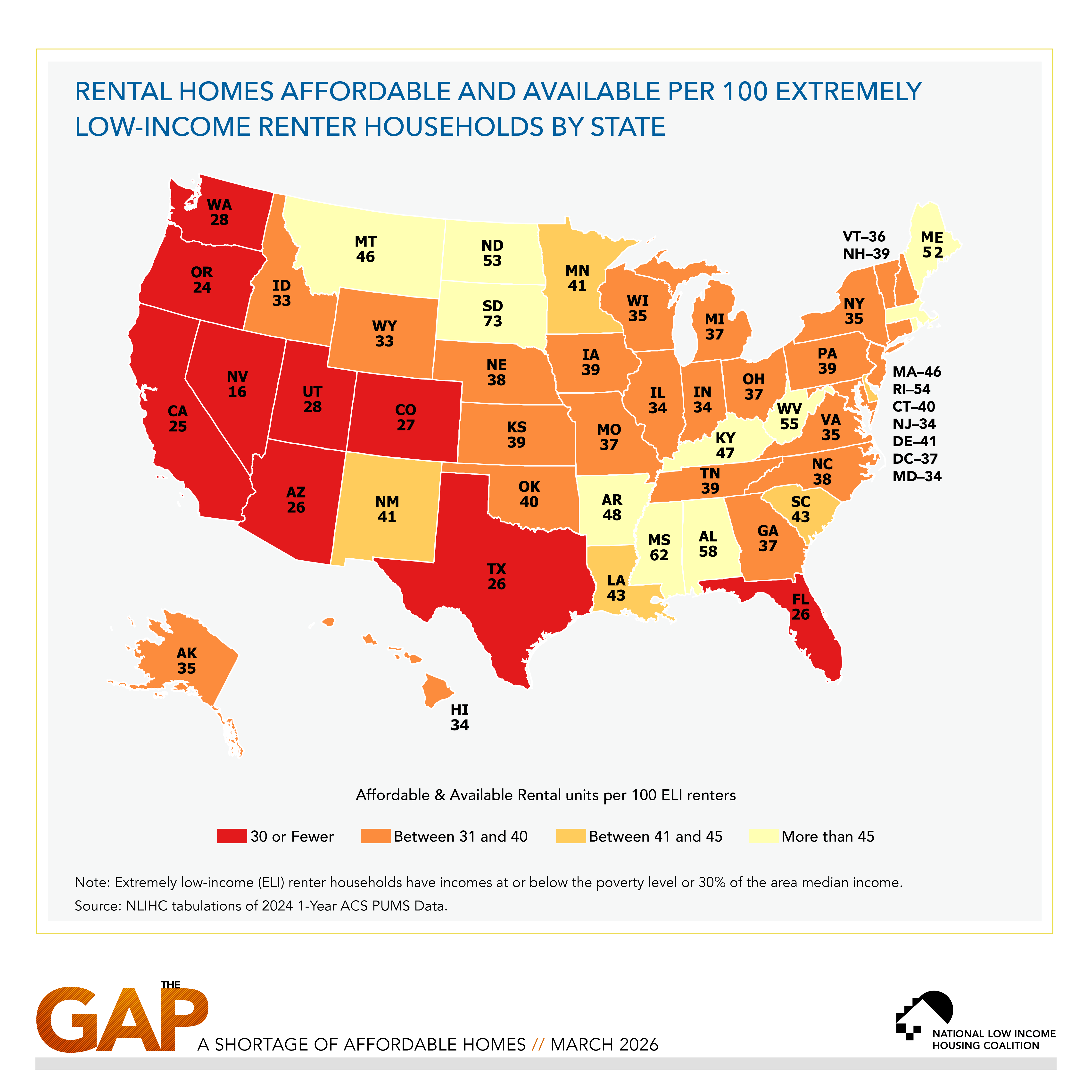
There is a nationwide shortage of affordable and available rental housing, with the greatest disparity found among the lowest wage earners. Compared to other states, Ohio ranks near the middle of the pack with respect to housing affordability. A new report by the National Low Income Housing Coalition (NLIHC) and the Coalition on Homelessness and Housing in Ohio (COHHIO), finds a sustained and systemic affordable housing shortage across the country, with just 35 affordable rental homes available for every 100 extremely low-income households nationwide.
On par with the national ratio, Ohio has a deficit of 266,000 affordable rental units, resulting in only 37 affordable homes for every 100 extremely low-income renters in the state.
About the Gap Report
The report, The Gap: A Shortage of Affordable Homes, was released earlier this month and examines the affordability of rental homes for households of different income levels nationwide and in every state and major metropolitan area. Housing is deemed affordable when rent or mortgage payments plus utility costs do not exceed 30 percent of a household’s income.
Households spending more than 30 percent of income on housing and utilities are considered housing cost-burdened, and households spending more than half of their income on housing are severely cost-burdened.
The Gap Report includes a focus on extremely low-income (ELI) renters with incomes at or below either the federal poverty level guideline or 30 percent of Area Median Income (AMI), whichever is higher. ELI households make up a large share of the overall renter population, accounting for about one-quarter of all renters nationwide and across the state of Ohio. Download The Gap Report on the left sidebar.

One in 4 of all renters nationwide and across the state of Ohio are extremely low-income households.
Compared to renters in other income groups, ELI households experience the most severe shortage of affordable housing. As a result, they are more likely than other renters to be severely housing cost-burdened. ELI households are also disproportionately headed by seniors, people with disabilities, and/or people of color.
The Gap Report finds that there is no state or major metropolitan area in the United States that has a sufficient supply of affordable and available homes for ELI renter households.
Housing (in)affordability in Ohio
According to the Gap Report, nearly half of Ohio’s 1.58 million renter households are housing cost burdened—paying more than 30 percent of income on rent and utilities.
Across the state, there are 422,000 ELI renter households and only about 157,000 affordable units available at this income level.
As a result, Ohio ELI households are paying a significant share of their income on housing; 73 percent of these households are severely cost-burdened, spending more than half of their income on rent, up from 66 percent five years ago.
73% of Ohio ELI households are spending more than half of their income on rent
As families spend more on housing costs, they have less available for other necessities, like food, healthcare, and transportation.
The number of ELI renter households and the gap in affordable housing available to them is disproportionately concentrated in Ohio’s major urban communities—the Big C’s: Cincinnati, Cleveland, and Columbus. Nearly 56 percent of all ELI renter households in Ohio live in these three cities. The ratio of affordable housing available to ELI households is also worse in the Big C’s compared to the state’s ratio, with only 27 units available per 100 households in Columbus, 32 per 100 in Cincinnati, and 36 per 100 in Cleveland.
Homelessness and the affordable housing crisis
According to advocates like COHHIO and the National Alliance to End Homelessness, the persistent and pervasive shortage of affordable housing is a significant root cause of homelessness, despite growing narrative that homelessness is a result of personal failure, mental illness, or substance addiction. Low-income renters who spend a large share of their incomes on rent often lack the resources to withstand a financial crisis, making them especially vulnerable to homelessness. Individuals and families in emergency shelters or on the streets are unable to regain safe, stable housing because there are no affordable options available to them.
The affordable housing crisis strains the homeless system on both the front-end, with severely cost-burdened households at greater risk of falling into homelessness, and the back-end, by hampering the ability of households to effectively leave homelessness.
Many individuals and families experiencing homelessness have income—either earned income through employment, or benefit income like Supplemental Security Income or Social Security Disability Income. However, their income is often insufficient to cover the rising costs of rent. According to COHHIO, from January 2020 to 2025, the median rent for a two-bedroom apartment in Ohio increased 28 percent.
Today, renters in Ohio need to earn more than $22 per hour working full-time year-round to afford a basic two-bedroom unit.
This housing wage is far greater than what many of the most common jobs in Ohio pay, placing affordable housing just out of reach even to those working full time.
Households experiencing homelessness are not accounted for in the Gap Report as the analysis is based on the 2024 American Community Survey—a survey of household addresses. As a result, the report authors include a caveat that the gap figures underestimate the actual need for affordable and available housing when considering individuals and families experiencing homelessness.
Advocacy and policy solutions
The Gap Report attributes the lack of affordable housing to systemic failures in both the private market and public policy.
It notes that the private market, without subsidy, cannot produce or maintain housing at rents sustainable to ELI households. However, housing assistance programs meant to help these households only reach about one in four who are eligible. The solution, then, is found in a two-pronged approach:
1) increase the supply of affordable housing available to the lowest-income renters through new production and preservation of existing affordable homes
2) expand rental assistance programs to bridge the gap between low incomes and rental costs.
The Gap Report identifies a number of federal policy solutions, including Congressional action on:
- The “Affordable Housing Credit Improvement Act” to reform the Low-Income Housing Tax Credit (LIHTC) program to prioritize renter households with the lowest incomes by offering additional tax credits for the development of deeply affordable units.
- The “Family Stability and Opportunity Vouchers Act” to provide 250,000 new housing vouchers and mobility counseling to families with young children.
- The “American Housing and Economic Mobility Act,” which would invest $445 billion over ten years in the National Housing Trust Fund to build, repair, and operate nearly two million homes affordable to ELI households.
Just recently, the United States Senate passed the 21st Century ROAD to Housing Act, which promises necessary reforms to facilitate the construction and preservation of affordable housing. The vote passed 89-10, demonstrating bipartisan support for affordable housing solutions. The bill moves to the House of Representatives, and advocates are urged to contact their local representatives for support. The NLIHC has resources to support federal advocacy.
In Ohio, COHHIO advocates for state investment in the creation of affordable housing and assistance for the state’s lowest-income households, including those experiencing homelessness.
Key advocacy priorities include:
- Preserve and expand the Ohio Low-Income Housing Tax Credit (OLIHTC), a state-level program established in 2023 with a $100 million annual set-aside to spur affordable housing development, complementing federal 4% and 9% LIHTC programs.
- Sustain and expand the Ohio Housing Trust Fund (OHTF), the primary source of state funding for affordable housing development and programs for low-income households.
The severe and persistent lack of affordable housing in our communities undermines family stability and well-being, children’s academic success, health outcomes, and the economic vitality of a region. Housing affordability is a universal concern and talking point for advocates across health and human services sectors. In the months that follow, we will cultivate opportunities for collective advocacy and education on the importance of housing affordability, especially for our most vulnerable neighbors.




.png)