When a community is hit by a crisis, the first responders are often not government agencies or hospitals. They are nonprofit organizations. When the safety net shatters, nonprofit organizations are the ones left to pick up the pieces. Yet despite being treated as emergency infrastructure in moments of crisis, nonprofits are funded and regulated as if stability, not volatility, is the norm. That mismatch is becoming one of the most pressing challenges facing health and human services systems today.
Demand for nonprofit services is rising
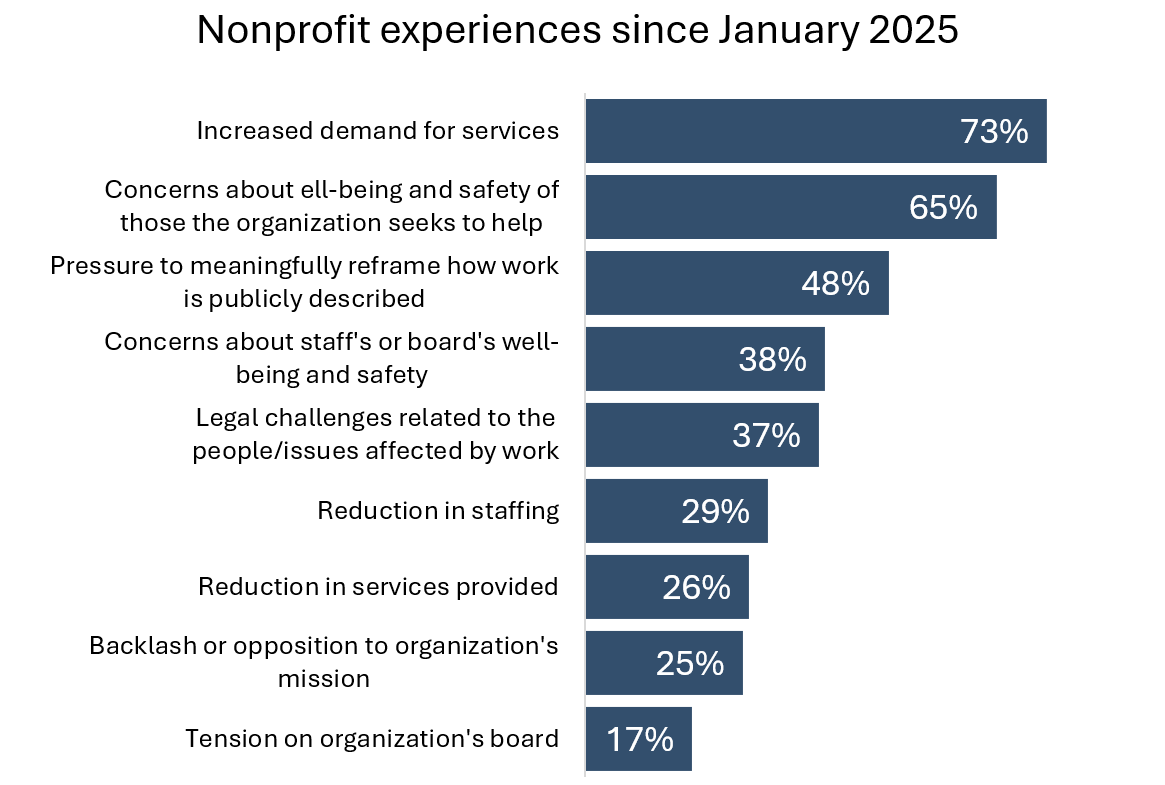
In a national assessment of the state of nonprofits, 73 percent of CEOs reported that their organization is experiencing a significant increase in demand for services. They described that national cuts to programs have reduced overall resources available, leaving nonprofit organizations facing higher demand with less support.
As a result, burnout of both staff and leadership has become a significant concern. Over the past few years, self-reported concern about burnout from nonprofit CEOs has increased, with 46 percent saying that burnout was “very much a concern” in 2026. Nonprofit CEOs identifying as female had higher rates of concern about burnout. In addition, 96 percent felt that burnout was impacting their staff in some capacity.

In addition to increasing demand, nonprofits are asking to do more with less. Thirty percent of nonprofits have cut staff. Of those who experienced a reduction, 57 percent indicated that it was by more than 10 percent, with one in four reducing by more than 25 percent.
With more people seeking help and fewer resources to respond, nonprofit organizations are needing flexibility in funding options.
Most nonprofit funding is structured around discrete programs, fixed grant periods, and narrow definitions of “allowable costs,” often with no room to support operating costs and staff paychecks. This model assumes that need fluctuates modestly and predictably.
However, this assumption no longer reflects reality. Over the past several years, nonprofit organizations have been asked to simultaneously respond to:
- rapid policy changes that affect eligibility for benefits and organizations’ ability to do their work,
- rising food, housing, and childcare costs,
- workforce shortages across health and social services,
- increased behavioral health and substance use needs, and
- new compliance and reporting requirements tied to public funding.
In a perfect world, each change on its own may be manageable. But together, they create a state of operational instability.
Compliance shifts, language changes tied to federal funding, and evolving certification requirements have increased administrative burden for nonprofit organizations without increasing service capacity.
Almost half of nonprofits said that they feel pressure to meaningfully reframe how their work is publicly described. Another third said that their organization has experienced legal challenges related to the people or the issues they work with. The result is a system where organizations are expected to adapt like emergency responders but are funded like static service providers. When federal or state policies shift quickly, nonprofits are often the first, and sometimes only, place people turn for help.
When volatility becomes the norm, the first things to erode are not always visible to the public.

Staffing is often the earliest place of collapse. Nonprofits often compete for workers in the same labor market as hospitals, schools, and private employers, but with fewer resources to raise wages or offer stability.
National data show that 22 percent of the nonprofit workforce experiences financial insecurity themselves, even while delivering essential services.
Fewer staff and an ongoing crisis response means that organizations have less time and fewer resources to invest in upstream work, like outreach, education, and early intervention. This upstream work often helps to reduce future demand. Systems coordination also suffers.
When organizations are forced to operate in survival mode, collaboration becomes harder, even though coordination is most needed during periods of disruption. Even so, half of nonprofit CEOs report initiating new partnerships or collaborations (excluding funders) in response to the current context, most commonly by sharing services with other nonprofits and working with cross-sector partners like local governments and businesses.
Planning for a volatile future
Almost 60 percent of nonprofit CEOs say that since January 2025, it has been harder to secure foundation funding. Almost 50 percent say it is harder to secure federal funding. If volatility is not a temporary condition but a defining feature of the current environment, then resilience must be built intentionally.
That means:
- more flexible, reliable funding streams
- investment in staffing and core infrastructure
- longer-term, unrestricted support
- stronger cross-sector coordination
Communities do not lose stability all at once. They lose it when the systems designed to catch people are stretched beyond what they were ever built to handle.
A recent survey of members of the Cuyahoga County Human Services Chamber explored how the policy changes and funding volatility have affected their organization, staff, and the clients they serve. Local results will be shared in the coming weeks.