

Ohio has long relied on the Supplemental Nutrition Assistance Program (SNAP) as a stabilizing force for families and local economies, especially during economic slowdowns. That stability has been under threat.
Congress passed HR 1 on July 4, 2025, which included the biggest cuts to SNAP in program history, representing $187 billion—20 percent of total program spending—over the next 10 years. Food Research and Action Center shared some data that put Ohio’s position and recession risk into perspective.
Ohio’s new SNAP administrative costs
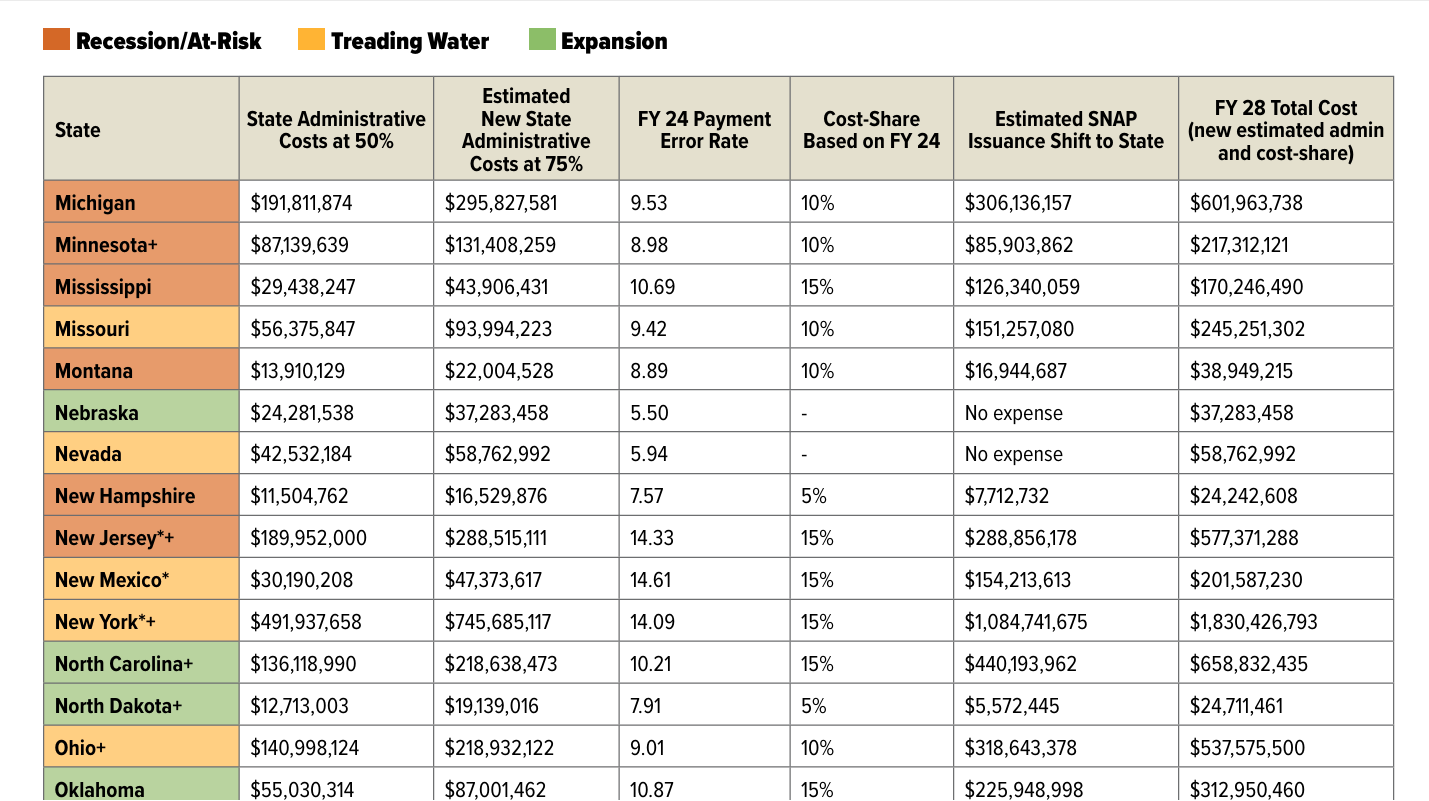
New analysis from the Food Research and Action Center (FRAC) shows that under the budget reconciliation law, H.R. 1, Ohio would face hundreds of millions of dollars in new SNAP costs over the next several years—costs the state has never had to budget for before.
SNAP food benefits are fully federally funded, and Ohio shares administrative costs with the federal government. Under H.R. 1:
- Ohio’s share of SNAP administrative costs would increase from 50 percent to 75 percent beginning in fiscal year 2027.
- Starting in fiscal year 2028, Ohio would also be required to pay a share of SNAP benefit costs, based on its payment error rate.
- Estimated SNAP issuance shift to Ohio: $318,643,378
Ohio’s total SNAP cost exposure is projected to rise to roughly $651 million per year
According to FRAC, Ohio’s SNAP administrative costs at the current 50 percent match total $218.9 million. When the higher administrative match and benefit cost‑sharing provisions take effect, Ohio’s total SNAP cost exposure is projected to rise to roughly $651 million per year.
That represents a dramatic shift in responsibility and ongoing strain on the state budget.
H.R. 1 also requires state and county governments to start paying much more for the administrative cost of SNAP. This is a reduction of $67+ million per year in federal reimbursement for state and county agencies who administer SNAP in Ohio.
This is a reduction of $67+ million per year in federal reimbursement for state and county agencies who administer SNAP in Ohio.
The changes create a fiscal environment where states will have to shift funds from other vital public services, choose how to cut SNAP benefits and restrict the number of people getting help, or opt out of having a SNAP program entirely.
Error rates and administrative accuracy
One of the most overlooked aspects of the cost shift is how strongly it ties Ohio’s future costs to payment error rates. These error rates largely reflect administrative complexity, staffing capacity, and technology—not fraud.
Ohio, like many states, experienced administrative disruptions during and after the COVID‑19 pandemic. Under the new law, even modest fluctuations in error rates could translate into tens of millions of dollars in additional costs, creating volatility that makes long‑term budgeting difficult.
As Ohio is asked to pay more for SNAP, it may have fewer resources to invest in the staffing and system upgrades that help reduce errors in the first place.
SNAP impacts on the local economy
The SNAP cost shift in Ohio is especially concerning given broader economic uncertainty.
SNAP dollars support grocery stores, farmers, and food retailers across Ohio. More than 1.5 million Ohioans use SNAP to help buy groceries and every $1 in SNAP spending generates $1.74 in economic activity. This means that households receiving a total of $265 million per month in federally funded SNAP benefits generate a total economic impact of $4.9 billion per year in Ohio.
More than 10,000 grocery retailers in Ohio accept SNAP benefits.
Because SNAP is used like regular cash or credit in store, the impact on local economies is outsized compared to other public benefits programs. More than 10,000 grocery retailers in Ohio accept SNAP benefits. Some grocers see more than 30% of their revenue from SNAP purchases. When states face pressure to cut benefits, tighten eligibility, or divert funds from other programs, families and local economies feel the effects first.
Workers are impacted as well, with 9,000 grocery-industry jobs across Ohio generating more than $320 million in payroll at stores, from bodegas to supermarkets.
For Ohio lawmakers, advocates, and community leaders, the message from the numbers is clear: this is not a marginal policy tweak. It is a fundamental shift that puts Ohio families, and Ohio’s budget stability, at risk.