Poverty & Safety Net
Article

Congress must postpone unprecedented SNAP cost shift to states

Rachel Cahill
Visiting Fellow | Public Benefits
Additional Contributors
No items found.
January 12, 2026
Read time:
Download Fact Sheets
Register now
Share this resource
Subscribe to our Newsletter
By subscribing you agree to with our Privacy Policy.
Thank you! Your submission has been received!
Oops! Something went wrong while submitting the form.
Download this as a PDF

Ohio deserves more time to implement SNAP changes from HR 1 and prepare for major new spending obligations.

In November 2025, the longest federal government shutdown in history drew the Supplemental Nutrition Assistance Program (SNAP) into the national headlines when 42 million Americans were forced to go without food assistance. Families went hungry, grocery stores lost revenue, and communities scrambled to pull together emergency food resources to respond to spiking need. Now that the shutdown has ended and media outlets have moved on, the SNAP program in Ohio—and across the country—still faces a looming crisis. Why? Because H.R. 1 (also known as the One Big Beautiful Bill Act), is forcing an unprecedented and untenable cost shift onto states, starting this year.

H.R. 1 is forcing an unprecedented and untenable cost shift onto states, starting this year.

Congress must postpone the looming cost-shift onto states like Ohio

Community Solutions has already written a great deal about HR 1’s impacts on SNAP and Medicaid (see here, here, and here). The federal implementation of the SNAP provisions of HR 1 are impacting states, and Congress must postpone the looming cost-shift onto states like Ohio.

The Ohio Department of Job and Family Services (ODJFS) and Ohio’s 88 counties need and deserve more time to properly implement HR 1’s changes to SNAP with sufficient guidance and resources, so that eligible families do not lose access to food assistance and Ohio taxpayers are not held liable for mistakes that inevitably come with rushed implementation. 

Key points

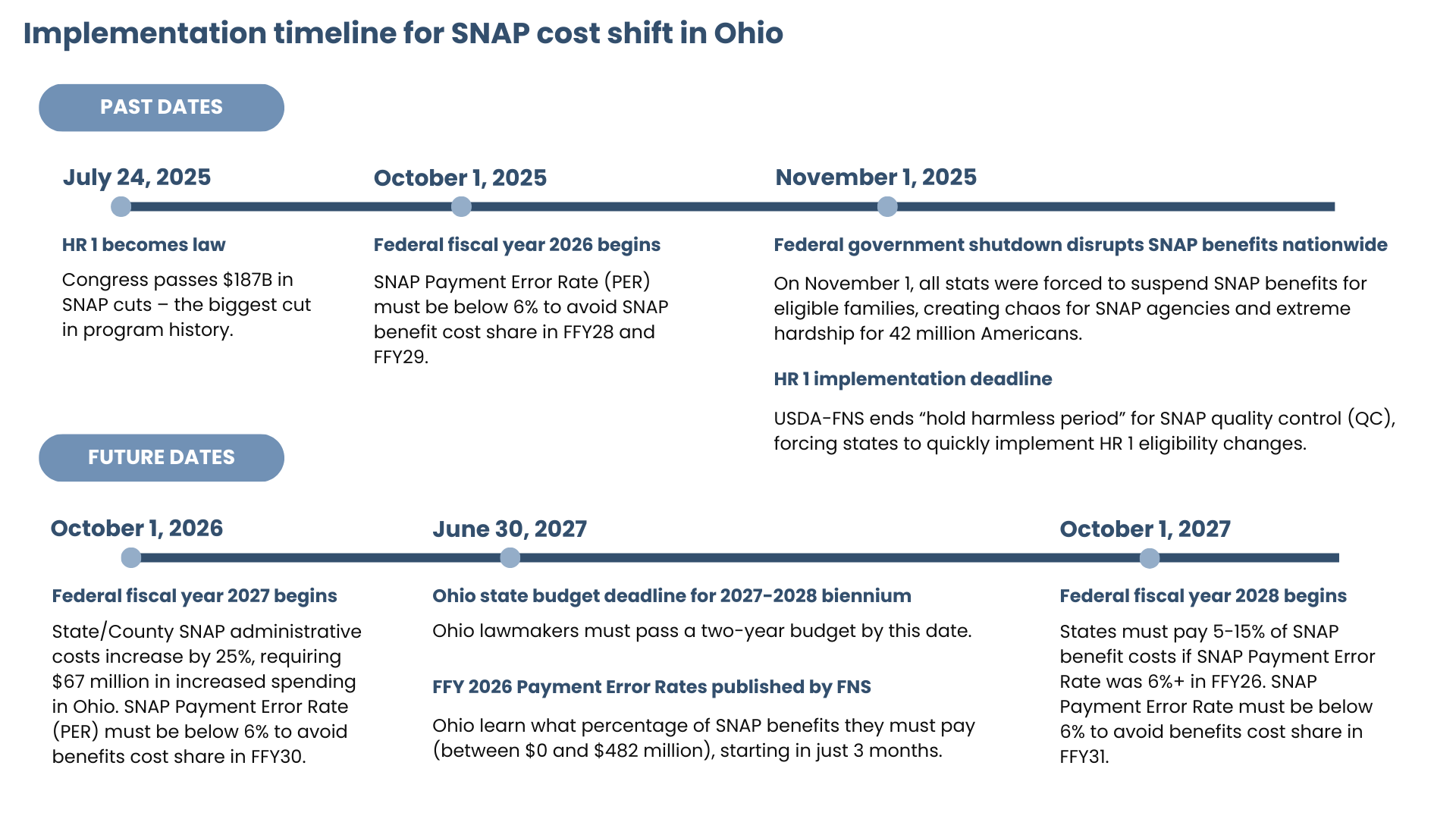
  • Congress passed HR 1 on July 4, 2025, which included the biggest cuts to SNAP in program history, representing $187 billion—20 percent of total program spending—over the next 10 years.
  • In HR 1, Congress created a cost-shift structure that unfairly penalizes states like Ohio who have worked hard for years to keep SNAP payment error rates low (between 6-9 percent), by requiring them to start paying a portion of SNAP benefits starting in FFY28 (October 2027). By contrast, states like Alaska with very high error rates, above 13.3 percent will not be required to contribute to SNAP benefits until FFY30 (October 2029).
  • The U.S. Department of Agriculture (USDA) delayed issuing implementation guidance on HR 1’s changes to SNAP eligibility until October 31, 2025 without giving states any grace period to update computer systems and retrain staff, breaking historical precedent and increasing the chance of payment errors. Furthermore, the federal government shutdown threw SNAP into chaos on November 1, 2025—the very same day USDA expected states to implement HR 1’s major eligibility changes.
  • HR 1 also requires state and county governments to start paying much more for the administrative cost of SNAP, starting even sooner (October 1, 2026). This is a reduction of $67+ million per year in federal reimbursement for state and county agencies who administer SNAP in Ohio. Now is the absolute worst time to reduce funding for county JFS operations, as counties will need to make significant investments in staffing and re-training, as well as process and technology improvements, to reduce SNAP payment error rates below 6 percent.
  • The simplest thing for Congress to do is delay the benefits cost shift to FFY30 for ALL states
The simplest thing for Congress to do is delay the benefits cost shift to FFY30 for ALL states.
Congress can fix this

The January 30, 2026 deadline to reach a spending deal for the remainder of FFY26 presents the best opportunity for Congress to fix the unintended consequences of HR 1 before they wreck Ohio’s state budget. The simplest thing for Congress to do is delay the benefits cost shift to FFY30 for ALL states—not just the poorest performing states.

Help us advocate before the January 30 appropriations package

The Center for Community Solutions encourages Ohio’s Congressional delegation to serve as leading voices to fix this unnecessary state budget crisis in Ohio. We invite local and state elected officials to join us in calling for such a provision to be included in the January 30, 2026 appropriations package. 
Download Fact Sheets

All Cleveland Wards

Download

Cleveland Ward 15

Download

Cleveland Ward 14

Download

Cleveland Ward 13

Download

Cleveland Ward 12

Download

Cleveland Ward 11

Download

Cleveland Ward 10

Download

Cleveland Ward 9

Download

Cleveland Ward 8

Download

Cleveland Ward 7

Download

Cleveland Ward 6

Download

Cleveland Ward 5

Download

Cleveland Ward 4

Download

Cleveland Ward 3

Download

Cleveland Ward 2

Download

Cleveland Ward 1

Download

District 15 | Federal Congressional

Download

District 14 | Federal Congressional

Download

District 13 | Federal Congressional

Download

District 12 | Federal Congressional

Download

District 11 | Federal Congressional

Download

District 10 | Federal Congressional

Download

District 9 | Federal Congressional

Download

District 8 | Federal Congressional

Download

District 7 | Federal Congressional

Download

District 6 | Federal Congressional

Download

District 5 | Federal Congressional

Download

District 4 | Federal Congressional

Download

District 3 | Federal Congressional

Download

District 2 | Federal Congressional

Download

District 1 | Federal Congressional

Download

Ohio Statewide Data

Download

Wood County

Download

Wyandot County

Download

Williams County

Download

Washington County

Download

Vinton County

Download

Wayne County

Download

Warren County

Download

Van Wert County

Download

Union County

Download

Tuscarawas County

Download

Stark County

Download

Summit County

Download

Trumbull County

Download

Shelby County

Download

Seneca County

Download

Scioto County

Download

Ross County

Download

Sandusky County

Download

Richland County

Download

Putnam County

Download

Huron County

Download

Portage County

Download

Preble County

Download

Pike County

Download

Pickaway County

Download

Perry County

Download

Noble County

Download

Paulding County

Download

Ottawa County

Download

Morrow County

Download

Muskingum County

Download

Morgan County

Download

Montgomery County

Download

Meigs County

Download

Monroe County

Download

Miami County

Download

Mercer County

Download

Marion County

Download

Madison County

Download

Medina County

Download

Mahoning County

Download

Lucas County

Download

Lorain County

Download

Logan County

Download

Licking County

Download

Lawrence County

Download

Lake County

Download

Holmes County

Download

Jackson County

Download

Knox County

Download

Jefferson County

Download

Hocking County

Download

Henry County

Download

Highland County

Download

Harrison County

Download

Hancock County

Download

Hardin County

Download

Greene County

Download

Geauga County

Download

Guernsey County

Download

Hamilton County

Download

Gallia County

Download

Fayette County

Download

Fulton County

Download

Franklin County

Download

Fairfield County

Download

Erie County

Download

Darke County

Download
Thank you! Your submission has been received!
Oops! Something went wrong while submitting the form.
Download report

Subscribe to our newsletter

5 Things you need to know arrives on Mondays with the latest articles, events, and advocacy developments in Ohio

Explore the fact sheets

Lorem ipsum dolor sit amet, consectetur adipiscing elit. Suspendisse varius enim in eros elementum tristique.

No Related Fact Sheets

Explore Topics

Browse articles, research, and testimony.

Poverty & Safety Net
Article

5 policy headlines you may have missed

Tara Britton
January 12, 2026
Article

5 reasons I'm starting 2026 with cautious optimism

Emily Campbell
January 5, 2026
Poverty & Safety Net
Article

Four ways to improve community preparedness and crisis support in our neighborhoods

Tamikka James-Haygood
December 22, 2025
Poverty & Safety Net
Article

Shaping change together: Policy Ambassadors at Community Solutions

Audrianna Rodriguez
December 22, 2025
Medicaid
Article

Do I meet Medicaid's new work requirements?

Emily Campbell
December 21, 2025