In the last month, the average price of gas in Ohio has rapidly risen from $2.76 per gallon to $3.87 per gallon. This forty percent spike in fuel prices is a result of armed conflict between the United States and Israel and Iran that has had a devastating impact on civilians and the region. It may seem callous to talk about something like fuel prices in the wake of a war, but the ramifications and ripple effects of rising fuel prices are necessary to understand.
Most of us will have already felt the impacts of these fuel spikes at the pump. According to the Bureau of Transportation Statistics, transportation costs are the second largest expense for households, accounting for thirteen percent of average household spending. However, this rate changes dramatically by income level, with lower income households devoting 31 percent of their income to transportation costs.
In the last month, the average price of gas in Ohio has rapidly risen from $2.76 per gallon to $3.87 per gallon.
The need for reliable and affordable transportation is something that comes up consistently in our work with organizations in the community. A lack of reliable transportation is a compounding barrier, making it harder to access basic needs like food and healthcare, engage with community resources, and maintain stable employment.
Geographic nuance ihelps explain the ramifications of this spike in fuel prices for Ohioans. Since 2006, The Center for Neighborhood Technology (CNT) has been refining a methodology to calculate the total housing and transportation costs for a region, aptly named The Housing and Transit Index. The Index takes into account variables such as housing density, the number of commuters per household, and public transit connectivity.
The map below shows CNT’s most recent 2025 data release, detailing the average transit costs as a percentage of median household income for Ohio’s 88 Counties.
The burden of rising fuel prices in rural communities
There is a clear pattern in the data: the residents of Ohio’s more urban counties are, on average, spending a smaller percentage of their income on transportation costs compared to more rural counties. This is an expected finding, as the Bureau of Transportation Statistics explains: rural households are traveling longer distances for their needs, and (out of necessity) have higher rates of vehicle ownership.
On average, households in rural communities typically spend about $1,360 more annually than their urban counterparts, with nearly two percent more of their household incomes devoted to transportation costs. Urban households are twice as likely (13 percent) to not have a car compared to rural households (6 percent).

Compounding ripple effects
Rising fuel prices and global supply chain instability will continue to negatively impact the cost of travel, shipping, many consumer goods, and food. Rising food costs are of particular concern, with the cost of fertilizer, food packaging supplies, and transporting food all sharply increasing as a result of starting this war. These increased food costs will almost certainly be passed on to the consumer and are unlikely to resolve soon.
This is happening at a time when the state of Ohio is debating how to reallocate SNAP dollars, after suffering a significant loss of federal dollars. Many households will be faced with untenable decisions.
As food becomes more expensive, more Ohioans will be forced to forgo or lessen their usage of basic necessities like utilities, living in adequate housing, transportation, and/or medical care.
Community Solutions’ previous research with lower income households in Cuyahoga County found that over sixty percent of respondents had to make some kind of tradeoff to afford basic necessities. The most often reported tradeoffs all included food.
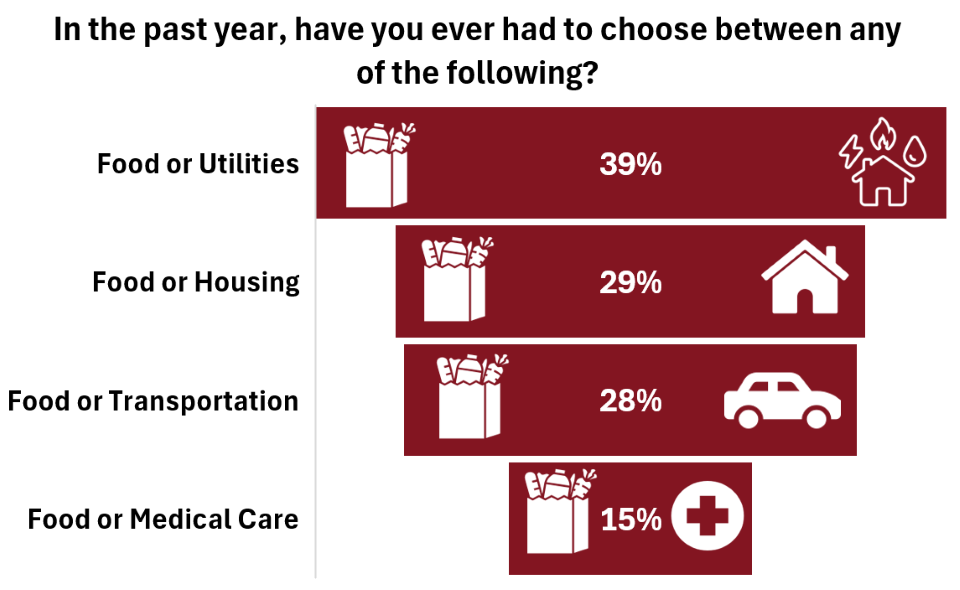
It is not hyperbolic to assume that, as food becomes more expensive, more Ohioans will be forced to forgo or lessen their usage of basic necessities like utilities, living in adequate housing, transportation, and/or medical care.
Programs and resources that can help
Because there are few safety-nets specific to transportation costs, eligible Ohioans struggling to afford their transportation needs will likely be forced to reduce their cost burdens through other programs like the Home Energy Assistance Program, SNAP/foodbanks, and Medicaid. What help does exist is fragmented and usually county specific.
Some limited one-time transportation assistance, such as vehicle repairs, downpayment assistance, and bus passes, can be found through Ohio Jobs and Family Services’ Prevention, Retention and Contingency funds, though eligibility and exact services offered vary by county. Many Community Action Agencies throughout the state also provide varying degrees of transportation assistance, such as Lorain County Community Action Agency’s By Car down payment assistance program, and Hocking Athens Perry Community Action’s on demand transit service.
Local Area Agencies on Aging can be a resource for older adults struggling with transportation needs. Depending on where one lives, the local 211 may be able to provide connections to local transportation assistance programs.
It is unclear what the future holds for this rapidly evolving situation. Some experts warn that we should expect fuel prices to continue to rise. Others report that even if the conflict were to end immediately, there will still be shortages in food and fuel. What feels clear is that many of us will be making adjustments to our lives and spending habits in the coming months. Especially our neighbors in more rural communities.