The recent government shutdown raised concerns for many Americans and created a wave of uncertainty that touched households across the country. People were laid off or lost employment; organizations struggled to compensate their employees, and SNAP benefits were cut or delayed. In Ohio, the impact was especially visible.
Nearly 1.5 million Ohioans rely on SNAP
The need for support is clear throughout Cuyahoga County. With 13.8% of households in the county relying on SNAP benefits, many residents depend on food assistance to help meet their basic nutritional needs. In Cleveland, this need is clearly reflected, where 24.5% of households receive SNAP. These figures highlight the many families across the region face ongoing economic pressures and how essential food support programs are for helping households maintain health, stability, and dignity in daily life.
The presence of so many families with children underscores the importance of investing in programs that strengthen family well-being.
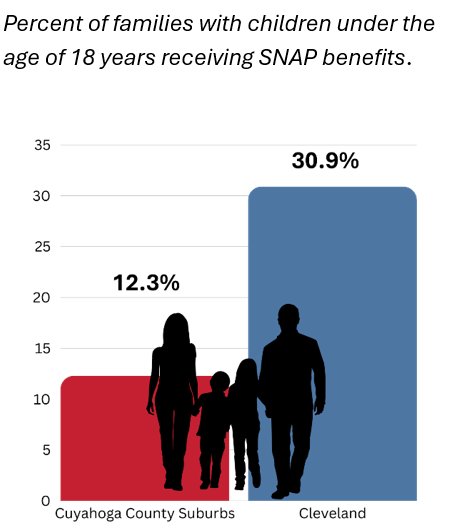
Family needs deepen this picture even further. In Cuyahoga County, over 125,000 households are raising children under 18. Among those households, 28,500 rely on SNAP for nutrition assistance with 30.9% of those families residing in Cleveland. Many households are balancing financial strain alongside the daily responsibilities of caring for children who depend on stable resources, structure, and opportunity. The presence of so many families with children underscores the importance of investing in programs that strengthen family well-being, promote stability, and ensure every child has the support they need to thrive. Even short-term disruptions can create immediate strain for families, reminding us that when systems falter, communities must work together to provide support and resilience.
Cleveland’s working families reveal a troubling reality
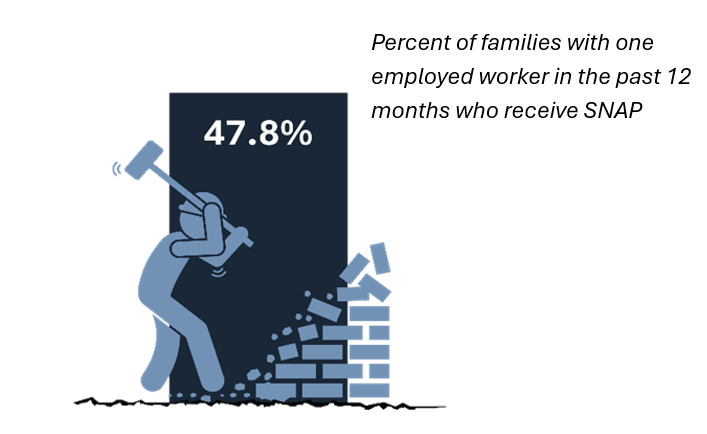
Employment does not always guarantee economic security. According to the U.S. Census, in 2024, there were approximately 74,600 families living in Cleveland. In the past 12 months, 12,953 households had one working adult, and another 4,651 had two or more workers, yet nearly half of these families rely on SNAP to provide nutrition for their families. This stark truth shows that wages and available jobs are often insufficient to cover basic needs, even for those doing everything they can to stay afloat.
There is a clear call to action for stronger community support, more equitable wages, and policies that ensure hardworking families are not left struggling in the shadows.
These realities from both Cuyahoga County suburbs and the city of Cleveland paint a shared picture of vulnerability, and an urgent need for collective action. Moments like these remind us that preparedness is not just about storing supplies; it is about building relationships, strengthening networks, and ensuring every neighbor knows they are not alone. Community resilience is something we create intentionally, long before the next crisis arrives.
Four ways to improve community preparedness
Whether a crisis is produced politically or environmentally, preemptively creating support provides protection from that crisis. Many communities have found ways to prepare, and we can learn from each other how to improve our own community’s preparedness.
1) Build hyper-local, ready to mobilize support networks
A key call to action is to develop neighborhood response groups that can mobilize quickly during uncertainty. This can be as simple as forming small circles of neighbors who check in on one another, especially seniors, single parents, or anyone living alone. A group text or neighborhood messaging thread can ensure that information about available resources, disruptions, or emergency needs spreads quickly and reliably. A few intentional conversations now can create life-changing support later.
2) Strengthen and diversify community food infrastructure
Food stability is one of the first and most serious concerns during a shutdown. By expanding community gardens, residents can grow fresh produce to supplement their own meals and share them with others. Community refrigerators, public fridges stocked with donated food, offer another solution.
Partnering with local businesses or organizations to host a fridge, secure volunteers, and coordinating regular donations can keep them accessible to anyone in need.
Partnering with local businesses or organizations to host a fridge, secure volunteers, and coordinating regular donations can keep them accessible to anyone in need. Additionally, adopting a “Know Your Pantry” initiative ensures every resident knows where local food pantries are located, when they operate, and what to expect. Knowledge, in this case, can prevent families from going hungry.
3) Create steady and flexible donation pipelines
Preparedness also means establishing consistent and predictable donation flows before a crisis hits. Communities can coordinate monthly non-perishable food drives, personal care item collections, or fundraisers that support local emergency assistance programs. Schools, faith groups, and small businesses can serve as reliable drop-off points, creating a distributed network of support.
4) Share information widely and intentionally
One of the biggest obstacles during the shutdown was that many people simply did not know what options were available to them. Making resource-sharing a daily practice can change that. Posting support services on community boards, sharing pantry and hotline information online, and attending workshops on food assistance or unemployment rights all help ensure that the right information reaches the right people at the right time. Engaging local experts at schools, libraries, or neighborhood meetings can also strengthen community awareness.
In times of uncertainty, preparedness is an act of care. By building networks, strengthening food access, supporting donation pipelines, and sharing information openly, we can ensure that our entire community is ready for whatever comes next. Together, we can create a future where no neighbor faces a crisis alone.